


For over five centuries, the dark residue at the bottom of a coffee cup has held secrets waiting to be unlocked. Coffee cup reading — known as tasseography or tasseomancy — is one of humanity's most enduring divination arts, weaving together culture, community, and the eternal human desire to glimpse what lies ahead. Its story begins not in a mystical cave, but in the lively, intellectually charged coffee houses of the Ottoman Empire.
The Birth of Coffee Culture (15th–16th Century)
The thick, unfiltered Turkish coffee, prepared by simmering finely ground coffee with water in a small pot called a cezve, naturally left a dense sediment at the bottom of the cup. As people turned their cups upside down and let the grounds dry, distinctive shapes and patterns emerged on the porcelain surface. It was almost inevitable that curious, imaginative minds began reading meaning into these patterns — and so tasseography was born.
Ottoman Coffee Houses: The Cradle of Cup Reading
By the 17th century, coffee cup reading had become so widespread and popular that it even attracted official attention. Sultan Murad IV (r. 1623–1640) attempted to suppress coffee houses — ostensibly because of the political discussions that took place within them — but the tradition proved impossible to eradicate. Coffee culture, and cup reading with it, continued to thrive in private homes and spread throughout the empire's vast territories.
Spread Through the Middle East and Persia
In Persia (Iran): The practice became known as fal-e qahveh (فال قهوه). Persian practitioners developed elaborate symbolic systems often interwoven with classical poetry, astrological belief, and Sufi mysticism. The practice became deeply embedded in women's social gatherings, creating intimate spaces for community and the sharing of hopes and concerns.
In the Arab World: Reading the coffee cup (qira'at al-finjan, قراءة الفنجان) became a cherished ritual across Lebanon, Syria, Egypt, and the Gulf. The art was passed matrilineally through generations, and women who possessed the skill were held in high esteem as community sages.
In Greece: Coffee cup reading (kafedomanteía, καφεδομαντεία) became so deeply interwoven with Greek social culture that it persists as a beloved tradition well into the 21st century.
European Encounter and the Victorian Fascination
The Victorians — with their simultaneous fascination for the supernatural, the exotic, and empirical classification — enthusiastically adopted tasseography and gave it its formal name (from the French tasse, "cup," and Greek graphia, "writing"). The 19th century saw the first systematic publications codifying cup-reading symbolism. Books like Telling Fortunes by Tea Leaves (1881) helped standardize the tradition for Western audiences, while also spawning the parallel tradition of tea leaf reading that became synonymous with British parlor culture.
20th Century: Cultural Identity and Global Diaspora
In Turkey, coffee cup reading became virtually synonymous with national identity. The phrase "Kahve içelim, fal bakalım" (Let's have coffee and read the cup) captures how deeply the practice is woven into Turkish social fabric. This recognition culminated in 2013, when UNESCO inscribed Turkish coffee culture and tradition — including cup reading as an integral part — on its Representative List of the Intangible Cultural Heritage of Humanity.
The Digital Age: Ancient Wisdom Meets Artificial Intelligence
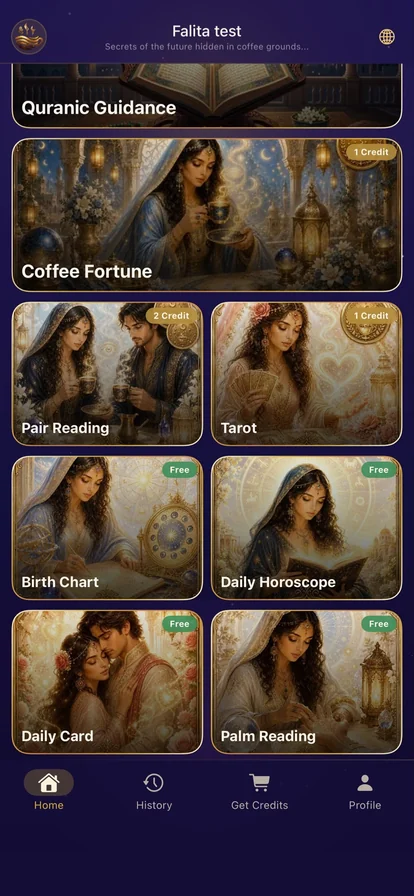
This technological evolution does not diminish the tradition; it amplifies it. The same fundamental questions that sent 16th-century Ottomans to their coffee cups — about love, health, career, and the unknown future — drive millions of users to coffee reading apps today. The medium has changed; the human need remains eternal.
From the coffee houses of Ottoman Istanbul to smartphone screens worldwide, coffee cup reading has proven itself one of humanity's most resilient and beloved cultural traditions. Its five-century journey from Yemen's Sufi monasteries to AI-powered apps is a testament to our unchanging need to find meaning in uncertainty — and to the extraordinary power of a simple cup of coffee to connect us to something larger than ourselves.
Frequently Asked Questions
Coffee cup reading originated in the Ottoman Empire around the 16th century, emerging in the coffee houses (kahvehane) of Istanbul. As coffee culture spread through the Middle East, North Africa, Persia, and eventually Europe, the practice of reading coffee grounds traveled with it.
Tasseography (also called tasseomancy) is the art of reading patterns in coffee grounds, tea leaves, or wine sediments to gain insight or divine the future. The word comes from the French "tasse" (cup) and Greek "graphia" (writing). It is practiced across dozens of cultures worldwide.
Yes. Turkish coffee culture and tradition — with cup reading as an integral part — was inscribed on UNESCO's Representative List of the Intangible Cultural Heritage of Humanity in 2013, recognizing its deep cultural significance.
Modern AI and computer vision have brought coffee cup reading into the digital age. Apps like Falita use machine learning to analyze photos of coffee grounds and provide traditional symbolic interpretations in multiple languages, making this ancient art accessible to a global audience.